“Writing shit about new snow
for the rich
is not art.”
– Kobayashi Issa
(trans. Robert Hass)
We’re entering the official “late winter” season in the Japanese Poet’s Meteorological Service forecasts, according to the saijiki, the book that regulates the topics of seasonal haiku in Japan. Here is what we should expect in poetic weather through February, mostly with completely inept modern translations courtesy of yours truly.
Shorter Days
First off, as usual, the short days of winter, or tanjitsu, (“short days”). I’m leaving the office to a nighttime sky and finding it difficult to run outside given the sting of the air and general unpleasantness of breathing ice into my lungs. Even the cats are gone.
The days get shorter
streets light up quickly,
sake goes quickly.
– Ikenouchi Tomojirō
Ice
Here in Fukuoka we have an outdoor ice skating rink, which doesn’t involve ice. Instead we have plastic gym mats with a hard crust that you skate over with real blades. The issue is that you can’t push like you would expect, because there’s no groove cut into the ice. You just slide around like a stupid baby deer.
A tossed pebble soars,
but sliding over the ice
it comes to a stop.
– Okamoto Kazahiko
Low Overnight Temperatures
There’s no central heat in Japan, so if you don’t buy a $1000 air conditioner you’re stuck with a space heater, which you usually turn off at the last possible moment before you fall asleep. Within the hour, the room freezes again, and by morning I typically have a cold-induced seizure while brushing my teeth. I run the hot water in the shower from the second I wake up, and actually towel off with the water running.
Basho notes the cold night:
I’m lying covered
beneath my futon, and still
this night is so cold.
– Bashō
Typically, you sleep on top of the futon, so Basho is basically sleeping under the mattress to stay warm. And here’s Sampu, seducing his blanket:
Moonlight’s bright for love,
So quilt, come hold me closer —
Passionate shivers.
– Sampu
You will see a hawk
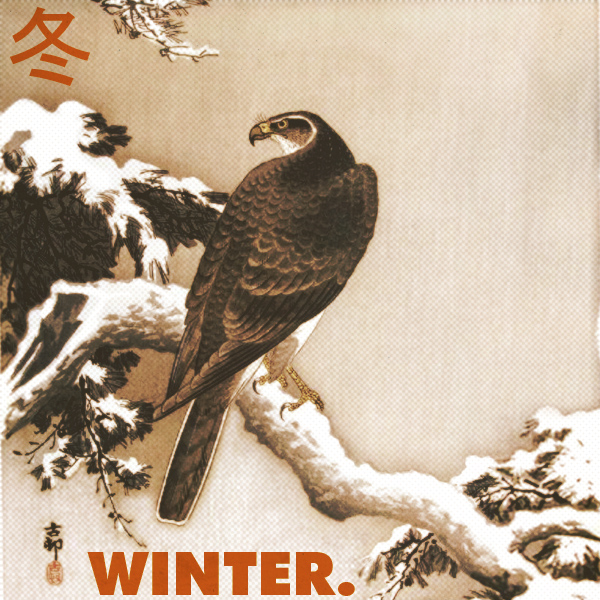
The saijiki suggests that you will see a hawk in the wintertime, and goes on to assert that hawks are the number one coolest bird. So you should be stoked when you see it.
Among all the birds
you were born a hawk.
Lucky, lucky hawk!
– Hashimoto Keiji
The UVA English-language seijiki explains this poem brilliantly: “This one praises a particular specimen on its good fortune at having been born a hawk and not some other kind of bird. One can sense the depth of the poet’s love for hawks.”
Crows don’t get the same respect from Basho:
This snowy morning
I hate that black crow —
But he’s beautiful!
Fresh blowfish
Pufferfish – fugu – are caught and eaten in the west of Japan during the winter. Famously, they have to be prepared properly or you’ll die from eating them. But even eating them properly seems to have its risks:
Ate a few blowfish
and woke up the next morning
with a full-grown beard.
– Enomoto Fuyuichirō
(My guess is that he’s referencing the hairs on his face blowing up like a threatened pufferfish).
Withered Pampas Grass
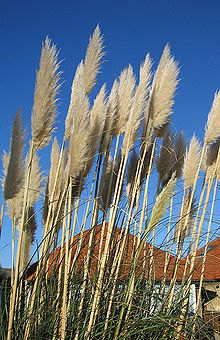
Pampas grass grows year-round, even in snow, and looks a bit like feathers. The phrase “withered pampas grass” is exactly 5 syllables, making it a go-to last line for haiku translators in a hurry. (None of the following are mine):
Hiding my tears
under a wide-brimmed hat . . .
withered pampas grass
– KikakuLonging after a boat
a dog on Yodo Plain . . .
withered pampas grass
– KitōWater-ripples
make no shadows–
withered pampas grass
– Watanabe SuihaWhen I too die
place me near this monument
withered pampas grass
– Buson
This has inspired me to write my own:
Withered pampas grass
Yeah, it’s withered pampas grass —
Withered pampas grass.
The original Japanese for “withered pampas grass,” kare susuki, has a sharper sound than the clumsy English translation. Even mine somehow sounds a bit elegant:
Kare susuki,
hai, kare susuki desu —
kare susuki.
The Thaw
Feb. 3, the last full day of the late-winter season is Setsubun, “seasonal division,” or often, “bean-throwing day,” the start of the spiritual “new year” as it’s the start of the thaw.
Unlike the traditional New Year’s Day in Japan, in which you visit a shrine, get purified and your fortune told, you spend Setsubun throwing beans at visiting demons to keep them from crossing into the spring.
It’s bean-throwing day!
Let’s go into the rice fields
and play with the mist.
– Mori Sumio
Happy Wintering.
This Japanese Life,
Its Facebook page beckons you–
Withered Pampas Grass.


Oh, withered pampas grass….
I translate haiku as part of my job, and I definitely remember that one. Kanazawa is the perfect place to enjoy the winter haiku and winter scenery. Thanks for sharing all the lovely poems.
My pleasure! Your job sounds kind of amazing.
Methinks you’re at the threshold of a new career: profound haiku writer! ;) Thanks for a very interesting post!
this is great. i never understood why i would want to read haiku but now i think its a good idea for winter commiserating…basho and i can suffer together under our futons
Pingback: On Letting Go of a Tree Branch in Japan | This Japanese Life. | 生命を外面九天です
Really enjoying your blog! For very non-Japanese haiku amusement, I put this together years ago; it’s been posting to its Twitter account (poetryninja) almost constantly since, and has far more followers than I myself will ever enjoy. http://www.poetryninja.com/