On Listening to The Strokes in Japan

In dreams, mind reading doesn’t have any side effects.

You have access to people’s thoughts. You know secrets. You find out things that make you angry, excited, sad, embarrassed. But if mind-reading could be the subject of documentaries and not just comic books, I bet our protagonist would resent the endless chattering and long for solitude.

You don’t notice how exhausting listening to a language is until you leave it behind. Sure, all of you back home can order food in a restaurant without nervously grinning and pointing wildly. Bravo, champs.

Your brain is also working overtime filtering out noise. You endure the psychic bombardment of cell phone conversations, aggressive customers, guys screaming from cars about how gay you look.

Functional illiteracy is a “mute” button. The chatter stops. There’s no meaning hidden in the roar, so you stop trying to find it. You become attuned to pure sensations: The sound of the train, cicadas, birds, the humming of fans.

Other people become mysterious. Their actions become spontaneous. The smallest series of communications are major feats of willpower and patience.

This might describe any expatriate in any country that supports the linguistically inept. But Japanese culture embraces silence. People don’t talk on the subway. Kids rebel by sleeping or staring out windows. People speak softly and keep to themselves in public spaces. The entire country is like a library in July.

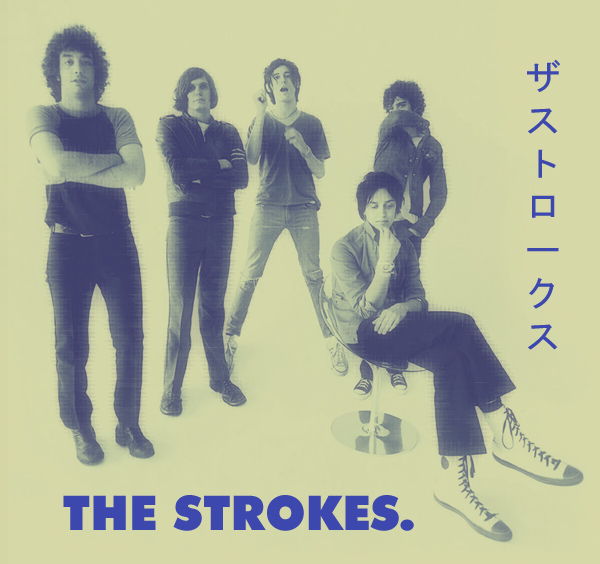
And yet, one afternoon of listening to The Strokes in Japan drowns out the entire island.

The Strokes, The Velvet Underground, Joy Division, The Jesus and Mary Chain, etc – pick whatever you want, if it’s loud and “Western,” it applies. Tinny, treble-filled, amateurish guitars shatter the careful silence of a Japanese city.

My first purchase in Japan was a stereo system. The first track out of shuffle was “You Only Live Once.”* Bike-chain percussion and stupid Julian Casablancas’ dorky lyrics gave me a kind of epiphany.

The “Here I am!” of underground indie rock runs so contrary to everything Japanese that you can’t help but love the sheer audacity of “American Rock’n’Roll.” It wasn’t the song, it was its connection to my own American-ness.

Since silence is distinctively Japanese – and noise, distinctively not – the process of filling a room with sound is instantly familiar and weirdly nationalistic. It’s assertive in a country that shuns assertions; it’s a bold claim in a land of socially lubricating ambiguity. It feels like home.

This poses something of a paradox: I’m in a country I embrace for its silence, but I love to fill my head with this crappy American noise. It’s that paradox of negotiating an identity in a foreign culture.

I have limited options. The humidity kills bagels and ironic T-shirts are redundant. What’s left is a sunny afternoon, an open window and my speakers turned too loud. It’s waiting for the cross walk light to turn green while a 9-year-old girl swings her lunchbox around as I’m listening to Cut Copy through ear phones.

Zen and the Art of Jeff Mangum
In America, I’d listen to music in a car. I drove a lot. The sound just floated in the air drowning out engine noise on long highway runs. I don’t listen to much music in Japan – I don’t usually have earbuds on the train; and I don’t listen to music while walking.

Since I’ve started with mindfulness practice – the art of acknowledging that your thoughts and emotions are a story you’re telling yourself, rather than rejecting or suppressing them – I’ve noticed what happens when I do listen to music: It’s actually doing the same thing.

When we’re present to emotions enough to identify them, music helps us fit it into the narrative arc of our lives. The classic example of this is the dorky habit of listening to certain songs while driving – or standing on a train – and imagining the music as a soundtrack in a movie where you are driving or standing on a train.

For actions, this can be a kind of distancing technique; it can pull you out of the present, and modify the story of your surroundings into an epic delusion of grandeur and adventure.

But I wonder, for emotions, if music doesn’t help us assimilate our internal stories as stories. If we’re feeling sad and listening to a sad song, it can help us look at the emotions and confront them – leading to a clearer head than if we’d ignored it or let it simmer.

Sometimes we listen to music because we want to feel something. But sometimes we listen to music because we feel something, and we need something else to help us make sense of it.

Posted in Culture Shock, Homesickness, Thinking | 9 Comments

On Ruins | 城跡

Ruins mark the space where something used to be: A castle, a government office, a police barracks. They outline a history, in the vaguest possible terms, of what was once worth something.

Embracing Decline
Growing up in a variety of batshit-crazy religions conditioned me to believe that if the container is gone, so is the essence. The body dies and the soul leaves. You drink out the Coke and you toss out the bottle. But in Japan, ruins mark a different relationship to decline and disappearance.

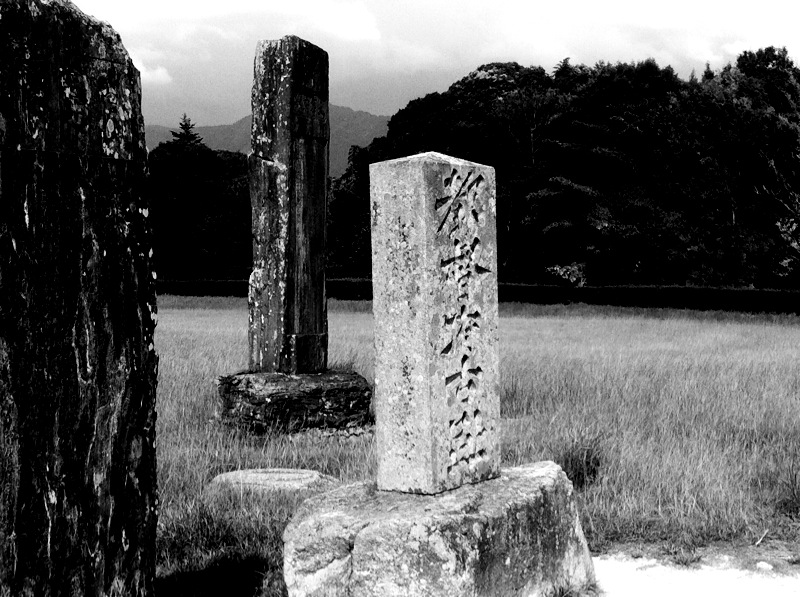
I can walk up a hill outside my house to stone stairs that stop abruptly on a platform covered with wild grass. There’s an abandoned playground to the side; an owl weather vane and then more stairs, which lead to (barely) a path in the forest and then, deeper in, a stone turned tall, written with a 1,000-year inscription in Kanji that I can’t read and which (for that reason alone) I imagine to contain some incredibly profound wisdom of the east.

I could hear thunder rumbling off by the city. Closer, the desperate chirping of dwindling and horny cicadas, the rustling of wind through trees, chanting monks and crowds of men cheering for a baseball game, the digital beeps of the railroad crossing. The only thing missing was an old man asking if I would accept a quest.

This scene, from “Funky Forest,” is a solid approximation. In Japan, if you aren’t too jaded or cynical about westerners “commuting with nature” in “Zen temples” like “douchebags,” you may be able to experience something simultaneously primal and simple, modern and overwhelming, and connective: A sense of peace that comes from man-made sounds invading the otherwise isolated natural world.

Growing up in America, where nature is a distinct and separate “other,” I could enjoy nature when we “went” hiking or camping. Nature was a planned event: Segregated, gone to and not gone through. In Japan, nature is thicker. It pushes up stones on the sidewalk, it floods canals, it sends boiling water out of stones. You feel like a tree when you sweat. And once a week, the local news reports on a monkey attack.

For this reason, I presume, the ruins of public spaces are left to be overrun by nature in Japan. Memory and the decay of the memory occur simultaneously. Nature is trying to change the world: You see suburban sprawl interrupted by lush forest; rain destroying laundry; apartments opening up to centipedes. The area surrounding the local shrine is hidden by thick vegetation; remnants of ceremonial stones show up periodically, and the scene is drowned in a mash-up of environmental sounds and the perpetually beeping racket of civilization.

Wabi Sabi
Buddhism presents three characteristics of the physical world:
1) Impermanence: Everything eventually melts or expands into nonexistence.
2) Permanent Appetites: Nothing will ever fully, finally satisfy us.
3) The lack of any permanent “self.”

All of these are packed into the idea of wabi-sabi, which celebrates objects that show awareness of their age and eventual fate, what Lafcadio Hearn described in his 1895 visit to Japan:

“Buddhism taught that nature was a dream, an illusion, a phantasmagoria; but it also taught men how to seize the fleeting impressions of that dream, and how to interpret them in relation to the highest truth. And they learned well. In the flushed splendor of the blossom-bursts of spring, in the coming and the going of the cicadae, in the dying crimson of autumn foliage, in the ghostly beauty of snow, in the delusive motion of wave or cloud, they saw old parables of perpetual meaning. Even their calamities — fire, flood, earthquake, pestilence — interpreted to them unceasingly the doctrine of the eternal Vanishing.”

The idea of ruins is this concept writ large. What is sacred and meaningful remains, though the building itself is left to dissolve. It celebrates the natural, inevitable end. The ice in your drink melts, and eventually your favorite restaurant closes. Photographs fade. People leave and people die.

Ruins in Japan are precious things left to find their own endings. These buildings don’t just fall into disrepair and collapse; they dissolve and, along the way, continue to reveal themselves, just as they did in their living forms.

Americans are preservationists; we fight death with all kinds of bullshit: Plastic surgery, historic registers. It’s not in our DNA to allow something to collapse without building over it. We’ve never even entertained the idea that leaving something to dissolve is a way of honoring its true nature. We demolish and rebuild, we “get over it.”

But the way that things end is still uniquely and exquisitely theirs.

Click below for notes. Continue reading

Posted in Temples and Ruins, Thinking, Uncategorized, Zen | 9 Comments

Video: Japanese Meat Announcements | 精肉店の交友わ

This thing shouts at people day and night in the deli section of the D-Value in Kasuya. There are no breaks for air. I have no idea where the man talking is, but this thing never stops shouting about meat.

This shopping center also offers hot dog sushi. It’s hot dogs, sliced and wrapped in rice and seaweed in a mayonnaise sauce. I guess it’s a Korean dish called “Kimbap” and by some weird coincidence there was a recipe in Salon last month.

Posted in Food, Video, Weird | Leave a comment

On Japanese Laundry | 洗濯

Forgotten spirits get their revenge in Japan by destroying your laundry. Appeasing them requires vigilance, patience and a calm disposition.

Pro Tip:
To calculate the percentage of clothing your washing machine will destroy, you can use this metaphysical equation:

X = S + B / O

Here, X = items of clothing lost, S = number of times you’ve accidentally worn shoes in your own hallway, B = the number of times you stood in your bathtub to shower and O is the amount of money you’ve spent on omiyage.

The Japanese Laundry Machine As A Failure of Coordination
First, clothes go into a mesh laundry bag, then into the machine. Japanese washing machines use a grinding motion guaranteed to damage an item of clothing every time it’s used. Instead of having the machine destroy your clothing, you use a bag which destroys your clothing while trapping it in lint and dirty water. Soap goes into the machine and you turn on a hose which literally has no access to hot water. The soap doesn’t dissolve properly in cold water.

Then it’s meditation time. The water fills, drains, fills, drains as a stuttering grinding mechanism twists your clothes into cotton mulch. Make a wish, then walk to the other room and wait for the machine to finish its black ceremony.

When you hear the chime, open the lid and assess the damage. My first offering was an Oxford shirt, which had small strings ripped out of the collar. Wash 2 was more benevolent and merely smeared my favorite shirt with a flower-scented, yogurt-textured soap residue.

Swaying in Idyllic Zephyrs
Since there are no driers* in Japan, everybody hangs everything on the porch. I imagined the wind rippling through my clothesline, sending stray moisture gently aside as a benevolent, two-scoops-of-raisins sun warmed them.

In daily practice: You battle against constant humidity. I’ve lacked a towel for two days on account of flash floods. I live in perpetual fear of finding a cicada in my boxer shorts. Crows fly off with socks.**

Because nature here has human intelligence and hates foreigners, you must deal with clothing at the exact right moment. Waiting for your dry clothing to get “dryer?” Your greed will be punished with a flash flood. Hang too many clothes on the line and something will fall into the muddy gutter of your concrete porch.

The Correct Way to do Laundry in Japan
Apparently, the correct way to hang laundry in Japan is to buy clothes hangers – the same kind that you have in your closet – and hang them that way; then use clothes pins to keep the fabric stuck to the hangers; then use a special plastic thing to keep the hangers attached to the clothesline. They look like the plastic adapter you would use to play a 45-speed record on a 33-speed turntable, only bigger.

I am not sure whether this experience is universal or limited to my particular economic class in Japan. I’m well-off; some people have to run a hose from their kitchen into a machine which then leaks water all over their floor. If you are coming to Japan be warned: Laundry in this country is inexplicably difficult.

Footnotes below.
Posted in Culture Shock, Weird | 8 Comments

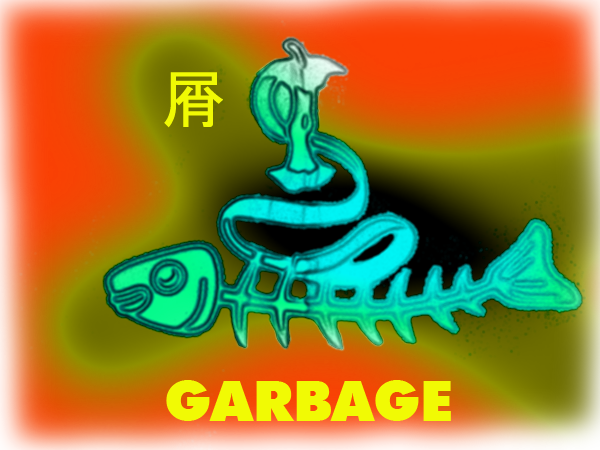
On Sorting Garbage in Japan | 屑選別

In Japan, every town has its own series of hipster garbage bags for specific categories of trash. My town has four; others have more: Kamikatsu, in Shikoku, has 44.

The bags are labeled with descriptions of what goes inside of them. If there is ever confusion, a 7-page comic book explains what goes where and on what days. Special garbage pickup days are also announced by a mysterious figure using bull horns mounted on electrical poles.

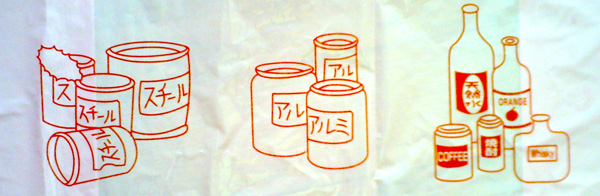
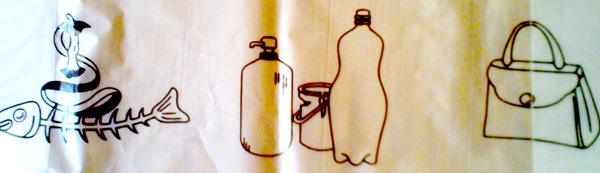
Based on the drawings on each bag, the garbage sorting goes like this:


Pink: Canned goods, more canned goods; whiskey bottles and orange juice.


White: Fish Bones, Cleaning Fluids and Ladies’ handbags.

Yellow: Tea Kettles, Soup Bowls and hair driers.

(Photo too boring to show)
Green: Recyclable Plastic Bottles.

It took a week or two but I’m used to it. Japan burns all of its trash, so in my town the bags are sorted into burnable (non-toxic, sorta) and non-burnable (toxic, sorta) categories. This reduces the trash that gets set on fire in the sea, which is a major source of pollution. The do-gooders in Kamikatsu have gone so far as to supply each household with an incinerator that makes compost.

In my town, the canned goods bag is for direct recyclables: Aluminium and glass. The fish skeleton bag is for “burnable” goods, so things like paper, certain kinds of biodegradable plastics and food waste. The Tea Kettle bag is for heavy plastics and metals which can be recycled or need to be destroyed in a special way. The boring green bag is specifically for plastic drink containers (But you have to remove the labels, since the labels are burnable). Cardboard boxes have to be returned to city hall, for some reason.

Different bags go out on different days. If you toss your trash improperly, the rubbish man has the right to return the garbage to your front hallway. Repeat offenders go to garbage-sorting school, something like a driver’s ed course only without the unnecessary excitement.

I live in an apartment building, so I’m not sure how anyone would be able to track the trash back to me. But I’m paranoid, because I’ve noticed a white moving van parked across from the rubbish bin on garbage days. I think it’s a stake out.

Also, binge-drinkers be warned: In 2008, a woman was sentenced to prison for disposing of her own vomit in a trash bag (Granted, she was a bulimic who disposed of 15 kilos [33lbs] in a single day). Since it’s all sorted eventually, the garbage-collecting folk aren’t interested in that kind of discovery, especially several days down the road. (Though I haven’t seen any clear explanation of what you should do with such a bag; I suppose burial is the best strategy).

The bags are about 350 Yen for 10; or about 35 cents US. They would also make amazing T-shirts. And check out GBA, a cool art collective in Japan that makes beautifully designed garbage bags.

Posted in Culture Shock, Weird | 2 Comments

On Noise Bursts and Japanese Television | 電視と噪音

My Japanese is horrendous, so I’ve had a lot of “arigatokudesai” moments (“Thank you you’re welcome!”) which can make a native speaker freeze (I presume out of fear of saying something equally nonsensical in English).

So at 6:00 p.m. when the city’s bullhorns played a tone and then spoke what was (for me) incomprehensible Japanese, it was totally creepy:

Typhoons were on my mind, so I turned to the TV. I inexplicably don’t have the national television channel (NHK) though a man comes to my door every month and asks me to pay for it. When I turned to the TV for information about a centipede invasion, two men wearing chicken masks were dumping eggs into ornate gift boxes set to a MIDI-synthesizer version of “YMCA.”

Other channels weren’t much different. One had a kind of crazy mix-of-mini-games where a male pop idol competed against teams of men dressed in Izod shirts, a bald man in a robe and a 1970’s-looking mom and her adorable 7-year-old daughter. The really galling thing is that the pop idol kept winning all of the challenges; after bowling down an obstacle course involving a curved wall, the pop-idol got so smarmy that he even high-five the little girl.

Japanese game shows seem to be modeled after “sports days,” in which competition is stripped of losers and everyone is awarded for trying. As a result, the games end up pure “fun” with no losers (and no prizes).

Based on my experience with Japanese TV, you are far more likely to see something as stupid as a guy getting electrocuted for $1 million in America. In Japan, the exhausting majority of prime-time (“safe”) TV is all about people enjoying themselves in the most boring way possible, including eating food (and marveling at how delicious the food is).

It’s kind of like watching reruns of America’s 1970’s TV, where game shows had celebrities and people watched to see celebrities have fun. It’s still part of American TV – it’s Jay Leno, David Letterman, anything “celebrity” driven. But those things have self-awareness now. Letterman’s TV jokes are jokes about TV. There’s a reflective self-awareness that seems to have been transcended or ignored completely by mainstream Japanese TV.

So while Japanese TV is garrish and ridiculous, it seems absolutely not “post-modern” at all, even if it looks like that from abroad. If there’s irony or cynicism about TV on Japanese TV, it’s not really coming through for me (though I also don’t have a clue about what they are saying. I study visual culture so I don’t have to learn languages).

The siren, by the way, is a broadcast from town hall, warning the kids from other parts of town to scram. They play every day at 6, on the nose. The sirens are also used to tell people about town hall meetings and special garbage pickup days.

Posted in Culture Shock, Thinking, Weird | 4 Comments