
On TV in Japan, Part 1

The TV show started out as some sort of dog melodrama.

There’s a really adorable grandmother scooping up a new, tiny dog with gigantic eyes and hugging it with a face so filled with love that the cameraman shows it for a full minute.

The date is typed on the screen with the sound of machine gun fire. Scene: The dog comes into the house. Grandma scoops it up, her face full of love, but then: The gnashing of teeth. The dog has bitten the woman’s ear. It’s bleeding, says her son.

“Ie, ie,” says the grandmother – it’s nothing! She loves that dog.

Machine gun fire shows the date. It’s the next day. Grandmother is coughing, struggling to walk with her friends. She dismisses her illness.

Machine gun fire. Three days later. A concerned daughter stares as grandmother shakes a thermometer. Later that night, two women in kimonos scream at grandmother as she’s passed out on the floor.

Machine gun fire. She’s in the hospital. Her face is purple. A doctor draws blood. Microscopic disease fills the screen, superimposed over adorable dogs and a single tabby cat. The music becomes cinematic, orchestral. A scientist stares through a telescope. Behind him, a doctor shakes his head. A corgi is chewing a bone. The grandmother is lying in a hospital bed. The music intensifies. A cat paws at a camera.

Images: The gnashing of nippy dog teeth. Blood on the ear. A computer animated infection. The music swells to a frenzy. The disease has infected her brain.

It’s spinal meningitis! Commercial.

Back. All the same stuff happens, but faster. Old lady is making tea now. A poodle in a pink shirt. Another dog with a bow.

TWIST: This is a TALK SHOW. A freeze-frame dissolves to show a host on stage with 5 people and their tiny dogs. Now, out of a shiny pod, a man in a suit emerges. The Kanji for “Old River” is shown. He’s a veterinarian!

TWIST 2: This is a GAME SHOW. The veterinarian answers questions that the five tiny dog people have guessed on, probably about a half an hour ago. He answers the questions, then the dog people’s answers are revealed. Are they the right answers? I don’t know!

ALSO: Why no monkeys? Surely someone in Japan has been infected with spinal meningitis from a monkey.*

The answers come from a close up of a dog and a thought bubble. Some Kanji comes up, and everyone cheers.

Answer: No, do not kiss your stupid dog on the mouth, because you will get a horrible debilitating disease. Is your shaved Corgi in a raincoat sleeping in your bed at night? Too bad, now you’ve got spinal meningitis. Also, if your golden retriever keeps drawing blood when it bites you, stop fussing with it and send it away.

Round up of how many points everyone has. For obvious reasons a Corgi’s head is superimposed on all of them and then a burst of flame covers the screen.

Now it’s all about training a basset hound to stop drooling, which is too disgusting for me to watch.

Continue reading

Posted in Culture Shock, Weird | 3 Comments

On Teaching English as an Out of Body Experience | 英語は儚いです.

Language exists inside of our skulls and escapes through the tongue: What Nabokov called “A fat sleek seal flopping so happily among the familiar rocks.” It’s a chunk of flesh that helps us push ideas out from our squishy insides and appease that primal urge to exude ourselves.

We are understood primarily by the sounds we make with our mouths. And so, standing in front of a classroom of bleary-eyed Japanese high school kids reading numbers for 50 minutes is bewildering on a fundamental, almost religiously loaded level. It’s like staring at a mirror and repeating your name.

In the classroom, language – my language, my “native tongue” – isn’t a vessel loaded by my complicated, deep thoughts and secret understanding of German poets. My ship is packed by a book telling me that today is phone number day and that I will instruct the students on how phone numbers sound in America, a topic I never noticed or cared about:

The first three digits are read as single numbers, as are the following three: four-oh-three, two-seven-one. The last four are doubled up as pairs: “Forty-one-seventeen.”

Do this stuff enough and you change. You hear dropped particles so often you make plans with “what time we do it?” You wonder whether an appointment really is a promise.

In the real world, words cut up the environment. They change things, accomplish goals, order a cup of coffee. Words plant themselves in other people’s ears and for a minute, you grow a little forest of meaning that you can both live in or argue about. (In Japanese, the word for I – – translates literally as “my part of our shared space.”)

But sometimes, teaching English in Japan feels like planting seeds in concrete.

“Hi how are you going?”
Consider the tragedy of carrying on a conversation only to realize that it is, literally, a memorized script. Students memorize long passages from the textbook and recite them to me in stumbling but clear English with no idea about what the words mean. And daily life has all sorts of moments where the proper words get stripped of any connection to real meanings:

Student: “Hello!”
Me: “Hello!”
Student: “Thank you for asking!” (bright smile and a wave).

Of course, some students communicate something of their inner lives in English. I’m not asking for poems about the triumph of human spirit. I’m happy when they can tell me about their favorite bands or ask me what movies I’ve seen. They talk about food because we can all understand what food is. They say they like onigiri, too, and we’ve connected.

That’s all you really need to remember that words can connect the content trapped inside of two skulls.

Erasing the board
And even teaching, it’s not so bad. I’ve been liberated by the realization that I am in the classroom but that I am not in the classroom. I’m an empty vessel: A signal without content, a radio tower broadcasting static, a guy making noises that students repeat with the intention of repeating them later to other English speakers to make a transaction.

Sometimes I move to the back of the room and look at what I wrote on the board as if I can’t understand it. With fluency, it’s almost impossible to forget that “four” means “four.” But teaching EFL with empathy means stopping yourself from knowing. And if you practice it, you can do it: Suddenly, you are outside of the black board, outside of your inner monologue, outside of everything, thinking about it as nothing more than sounds and pencil marks. And then you disappear for a second.

“Securely, for the chance!”
I realize, in those moments, the reason for all those inexplicable Japanese T-shirts, those billboards that don’t make any sense. It’s because the English language – obviously – lacks specific referral power in Japan. It’s a series of scripts and vocabulary words that are never really used to produce meaning.

Japanese, in Japan, is the language of poetry and novels, dense and rich and alive. English – and, because I speak it, me – we’re thrown out there for entertainment and foreign allure but never expected to mean anything real. *

As a teacher of a language, it’s tempting to think that you are that real thing – that the students, finally, will be able to speak to you. But it’s not that – it’s America, and entrance exams, and TV shows and Justin Bieber. You, you’re just the ship that gets them there.

Continue reading

Posted in Culture Shock, Teaching, Thinking, Uncategorized | 3 Comments

Video/Audio: Nakasu Festival, Taiko Calligraphy

Went to the Nakasu Festival this weekend in a district of Fukuoka usually known more for its hostess bars and seedier elements. The festival centers around a group of 50 women carrying a shrine on their shoulders through the city. They carry it a bit, stop, some sort of performance is held and then the women lift the statue again to carry it to the next site.

Getting large groups together to carry heavy objects is a pretty common festival theme here. Near Nakasu in Hakata, there’s a Yamakasa Festival, where naked men (save for a thong) wake up at 3 a.m. to run a 2km race through the city carrying a 1-ton statue to a shrine. The winning statue remains at the shrine for the rest of the year.

In Nakasu, 6 women stand on top of the beams carrying the statue, leading the chant in a call-and-response to the carriers. I was going to upload some audio, but no one wants to hear the 2 and a half minutes of 50 women chanting “Seya!”

So instead here’s an mp3 of another Taiko performance by the same guys in the video:

10 9 2010 8 39 PM – Taiko Drummers by onigiripod

Posted in Audio, Fukuoka, Video | 1 Comment

On Having Sushi Delivered by a Conveyor Belt in Japan | 回転寿司

Japan put a halt to the crazy sushi bullshit just after the California roll. Leave the Philadelphia roll to America. In this country, there are no catfish-and-cucumber rolls with picante sauce and names like Samurai Komodo Dragon Rolls.

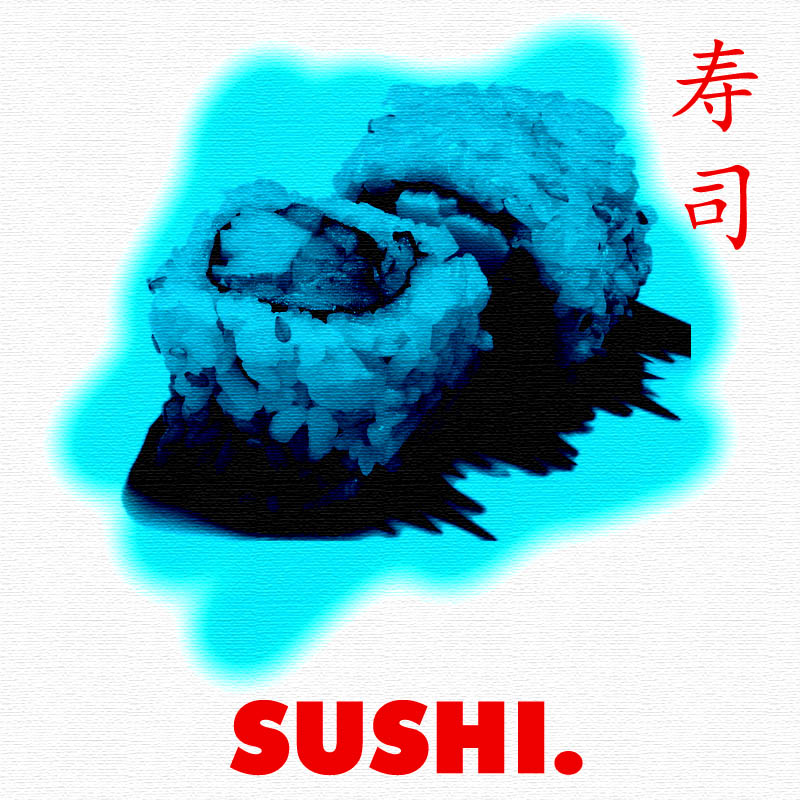
If you want sushi in Japan, you will get an expertly sliced piece of raw fish placed, with a dab of wasabi, on a small ball of white rice. It will be delicious, but not American delicious, and it will probably come to you on a conveyor belt: Kaiten Sushi – or Conveyor-Belt Sushi, or, if you are living in modern Japan, “Sushi.”

Sushi in the Age of Mechanical Reproduction
Long before the first conveyor belts began to roll coal out of devastated mountainsides, I imagine the DaVinci of fishermen sketching the device for posterity. “Maybe not today, but someday, this is how men will eat.”

The process is near-perfect: The belt runs clockwise, so you can hold chopsticks in your right hand while grabbing the plate with your left. It runs at a finely tuned 8cm per second, keeping the food moving without spoiling fish through aeration. Different colored plates mark the prices. At the end, the waitress tallies them up.

The sushi comes out by type: Three plates of fried shrimp, three plates of squid, three plates of natto and sea bream, etc. This triggers a hunting instinct and a finicky urge to wait. You don’t want the perfect plate of calamari to pass by when you are chowing down on mediocre sea bream.

It’s like playing “Hot or Not” with raw fish.

A Cold Fish Medium
At Genki Sushi in Hakata, you can order sushi through a television screen. There’s real food on the conveyor belt, but if you desire something on the TV, they’ll assign you a number and send it on a plate with a card. Other places have monitors with virtual fish.

Kaiten Sushi, though, has its downside: Traditional Sushi is practically nonexistent, going the way of bluefin tuna. In Japan, I’ve seen hundreds of Ramen and Udon places, but my hometown in Maine (with 40,000 people) had more sit-down sushi places than my current home, a suburb of a Japanese metropolis.

Sushi is Dead
I can’t speak for the nation as a whole – I’m in a region that celebrates its Ramen with as much ferocity as its baseball team – but traditional sushi is pretty much absent, with the low-cost Kaiten taking its place.

Barthes, in the last chapter of “Empire of Signs” before he started getting complicated – talked about the process of sushi as a chain: The chef (who doesn’t cook) is carving fish in the same way that calligraphers paint strokes; only instead of making words out of ink, he is making food out of fish. The conveyor belt, then, is like a printing press: cheap, affordable, accessible sushi for the masses. And with it goes the holiness of a hand-inscribed book.

It’s not an exaggeration. Sushi, for the purists, is an art form. Traditional sushi chefs spend 10 years in training and 3 years before they serve a single piece (Compare that to the 2 years for an Art School MFA and you’ll see that sushi is actually more rigorous, albeit more conservative). The first three years are spent learning how to select the fish. The next two years are dedicated to rice.

Reducing this process to one guy at the end of a conveyor belt carving up salmon bought in bulk at Costco kills off that exclusive culture. This would make Yoshiaki Shiraishi – who invented the conveyor-belt sushi system in 1958* – a kind of Andy Warhol** for sushi.

Shiraishi (“Sushi Innovator” Shiraishi, in his 2001 NYTimes Obit) built the conveyor system and a robot-based sushi-delivery system (which doesn’t have the same degree of success) after staffing problems hit his restaurant.

If there is real hand-wringing in Japan after 50+ years of conveyor belt sushi, I wouldn’t be able to understand it anyway. But in a country that is constantly negotiating rapid progress with a deep history – where shrines are sandwiched between industrial buildings and shopping plazas – kaiten-sushi stands as a complete compromise to modernity, a surrender.

But it’s delicious and costs 150 yen a plate. So I suppose modernity has its charm.

Continue reading

Posted in Food, Weird | 7 Comments

Audio: Dazaifu Jinko-Shiki Ceremony

Dazaifu Shrine by onigiripod

Recorded at the Jinko-Shiki (“God Procession”) Ceremony at Tenmangu Shrine in Daizafu, Japan, part of a Shinto tradition marking the Autumn Equinox. It’s a purification ritual for priests and ends with the lighting of 1000 candles.

The music reminds me a bit of Akron/Family without the noise, but maybe I’m crazy.

Continue reading

Posted in Audio, Shrines, Temples and Ruins, Zen | 1 Comment

On Japan’s Accidental Pot Culture | 日本乃過失は楓葉

Every so often I come across a 9-year-old kid in a “Ganja” T-shirt covered in pot leaves.

Or else it’s a book cover or pencil case with red, yellow and green colors in the background and the pot leaf outlined. Sometimes it has the word “Cannabis” in yellow. Sometimes it’s a T-shirt covered in a repeating pattern of marijuana leaves.

It’s present from elementary through high school, and it’s particularly shocking because Japanese drug policies are extremely restrictive: One gram of marijuana can get you five years in jail and up to $344,000 USD in fines. Foreigners will serve their sentence before being deported and banned for 10 years to life.

Marijuana Laws in Japan
There are no “class” distinctions for drugs in Japan, so marijuana = cocaine = crack = heroin, etc. A simple urine test is enough to merit a conviction and it can be administered based on suspicion, meaning that merely talking about marijuana use in public can get you convicted and deported if you’re within earshot of a bored cop (and in Japan, cops are usually bored: Outside of Hakata Station, one cop’s job is smiling on a small ladder while waving at people).

So, with the law coming down so hard on pot users, you would think parents and teachers would crack down on their 9-year-old’s celebrations of the stuff.

The problem is that marijuana laws are so restrictive that no one knows what it looks like. According to a 2008 survey, only 1.5 percent of Japanese citizens has smoked marijuana (Compare that to 42 percent of Americans).

Government statistics rank pot as the 6th most-abused drug; it falls behind the obvious (caffeine, alcohol and nicotine) but also behind speed and huffing paint. Combine that with a more restrictive legal status and you have a black hole of awareness.

Sure, hipper kids may see it in movies, or pick it up from context. And clearly people use it: There’s a head shop called “420” in a local dive-bar neighborhood, which sells pipes and other smoking supplies. Japan’s proximity to Thailand and other marijuana meccas ensures that there’s some available on the black market – and shady street merchants selling hand-made necklaces (exclusively after dark) are probably a good source.

The Wrong Leaf
So, yes: There are pot smokers in Japan. But everyone else is just super into leaf-peeping.

There’s a word for leaf-peeping; Momiji-gari, literally, “Maple-tree hunting.” The weather report in Japan tracks the change of foliage across the country; the fanaticism is so intense that a good number of Japan’s residents are convinced that it’s the only country that has seasons.

So ask the typical 9-to-17-year-old kid what the plant on their pencil case is and you will probably hear that it’s a maple leaf. He isn’t bullshitting you. Their parents and teachers will probably say the same thing. I’ve even seen the marijuana leaf used as a logo for a wig store. And even if the word “cannabis” appears with the leaf, it doesn’t matter: English is decorative, and almost never read (If English was read as a language, you wouldn’t have shirts that say “Work Hard, Play Hard, Tyrannosaurus Rex”).

Continue reading

Posted in Weird | 2 Comments