The “Gaijin Nod”


A friend from Venezuela, when we were in Prague, had a habit of making a small nod with his head toward fellow South Americans. An African-American friend from Detroit had the same habit in Germany.

“It’s the brother nod,” he explained. “It shows that, you know. I’m a brother. He’s a brother. I just like to say, hey. I got your back.”

Years later, in Japan, I find myself conflicted over “The Gaijin Nod.” The small moment of eye contact and tilt of the head that says, “Hey. I, too, am not from here. And I have your back.”

The sentiment seems absurd in Japan, where crime is low and intolerance of foreigners (white, western foreigners) seems confined to random acts of appreciation for an adequate use of chopsticks.

But it’s foreign to me, as a white dude, to identify with race. It triggers a defensive mechanism – the knee-jerk reaction to avoid the nod. Saying “Hey, you’re white*! Let’s be friends!” runs against all the sensitivity training I’ve ever had. In any other context we’d probably hate each other.

Self-Hating Gaijin
My desire to high-five every foreigner on a train is matched by my revulsion to the idea, and so I have to confront a stupid psychological condition: My nagging delusion that other people just don’t “get” Japan the same way I “get” Japan.

This, I acknowledge, is the douchiest trait I’ve ever had. But it swells up when I see loud groups of whiteys crowd into a train shouting, eating and cutting in line. The volume level of nearby foreigners directly correlates with my self-righteousness. I get all white-knight, and my princess is Japan. I don’t want to be reduced to the stereotypes those guys are producing.

So I sell out my Western-ness, as it were, and bow politely, let anyone older than me have dibs on seats, give the conbini cashier an “arigato gozaimasu” instead of a mere “arigato.”

Call me Uncle Tom-san.

A Theory
People come to Japan for one of two reasons:

  1. The mix of philosophy, history, beauty, silence and humility.
  2. The hot women and totally crazy anime, porn and nightclubs.

Is there any wonder that these two groups would find themselves in a civil war, with quiet nerdy kids with OCD on one side and guys who get off the plane screaming “Kabuki-cho, bro!” (and then, inevitably, end up speaking better Japanese because their rapidly acquired Japanese girlfriends teach them)?

Gaijin Complex
Of course, the OCD, high-functioning autistic expats aren’t purely awesome, either. It’s not like I’m enlightened because I’d rather read a textbook on Shinto than go to a Soapland. We’re just quieter and get ulcers instead of angry. But we also lean toward obnoxious cultural, historical and linguistic pedanticism.

Fellow ex-pat and musician/blogger/genius W. David Marx summed it up perfectly back in 2005:

All foreigners with interest in Japan hate all the other foreigners with interest in Japan. The Colonialists all like their ex-pat buddies and pubs, but the Japanese-speaking foreigner contingent is in constant battle with themselves, vying to prove linguistic abilities, obscure knowledge, and depth of societal penetration. I call this the “gaijin complex,” and I’m only finally finding my way out of it now after a long period of affliction and convalescence.

What’s funny is when I see guys who are at meetings for our jobs – the same job I have – who refuse to talk or make eye contact with other foreigners. When they do, it’s shifty-eye city. “Look, sorry, I’m just way more integrated than you, and it’s kind of  embarrassing.”

I have not reached this epic level of Gainjintensity because I’m too dumb to use the language. As a result, I can’t whip out my Japanese Language Proficiency Test score in casual conversation, or name-drop 16th-Century Feudal Warlords (OK, actually I can) or proper Shinto etiquette for shrines (OK, I can do that too).

OK, I do that stuff. A lot. That’s kind of my point. I’m kind of a douchebag.

Oh, Expatriates
In summary, being a foreigner in a homogeneous country requires some girding. The isolation and the need to express yourself through reductive language amplifies the weirdest parts of your personality. You ramp up the fundamentals. You’re treated as a celebrity so your personal eccentricities become overpowering. Suddenly, Theodore from Dallas becomes Texas Ted with a lone-star state belt buckle, cowboy hat and tasselled shirt swinging a lasso around on the way to the ramen stand.

When the most common traits of expats are either quiet nerds fostering passive-aggressive rage, high-stress business types fostering toxic arteries, or high-energy party animals fostering nothing at all, you are bound to create some seriously weird people.

By and large, the expat community is also filled with plenty of cool people with a taste for adventure and a bizarre sense of humor, with all the awesome side-effects that spill out of that.

But like any isolated culture, it can create a feedback loop that does weird things to your personality. Some of those things are alright, some aren’t. But check in, every once in a while, to make sure you’re OK with what it’s doing.

Click “more” for footnotes.
Continue reading

Posted in Culture Shock, Thinking | 10 Comments

Japan’s Least Popular Arcade Game |

I’ve developed something bordering on fanaticism for the Taiko Drum game and spend way too much money and time in video arcades as a result.

“Game Centers,” as the kids call them, are usually a few floors with gambling on the top, old school NES and cigarette smoke in the basement and claw machines in between.

There’s a few big machines: Dance Dance Revolution or the Taiko game are usually busy with players and spectators. This is never the case for a machine called Cho Chabudai Gaeshi, or “Flip the Dinner Table.”

The premise of “Flip the Dinner Table” is that you are angry. You can choose to be a jilted bride, a middle-aged woman annoyed at the waiters in a host club, or a dad whose kids don’t listen to him. The new version adds a fast-food clerk, a salaryman and a teacher.

As the title implies, the game doesn’t get too complex. You pound your hands on a plastic table. Then you launch the table upwards in a cathartic spray of pixelized devastation.

Throwing the Table is, apparently, a “Japanese thing.” Wikipedia, which you should just read instead of my blog, says:

Literally, it describes the act of violently upending a chabudai as an expression of anger, frustration, and disapproval. Video game designer Shigeru Miyamoto characterized chabudai gaeshi as an “action of old-fashioned Japanese fathers” which “would destroy the family” if attempted literally in modern Japanese society. Chabudai gaeshi may also figuratively describe an analogous outburst and upheaval.

Releasing a game based on “destroying the family” is certainly a recipe for fun. But I question the wisdom of marketing this thing in Japan, where people hesitate to reveal anger or frustration in a social setting. The American equivalent might be a game where you weep more humiliatingly than your opponent.

The game is two years old. It keeps getting updated but I never see anyone playing it. And I go to the game center twice a week to play Taiko No Tatsujin, arguably the most adorable game ever invented (and it usually has a line). Here’s me playing Taiko No Tatsujin*:

Continue reading

Posted in Fun, Uncategorized, Video, Weird | 4 Comments

On The Bullet Train | 新幹線

Maybe the Shinkansen, Japan’s cross-country bullet train, is only interesting until you’ve ridden it.

I was ecstatic to take the Shinkansen on a trip from Fukuoka to Tokyo. It’s a 14-hour drive by car achieved in a little under 5 hours at 186 mph. We’d see the entire countryside of Japan at blinding but comfortable speeds and plenty of leg room.

When the Shinkansen arrives, it keeps going. There were 19 cars on our trip. My girlfriend got in at the tail end of the train once and took 20 minutes to walk to the right end. When she got to her seat, the train had arrived at her destination – a journey trains usually make in 2 hours.

When the Shinkansen gets out of the gate, it’s not like being shot out of a cannon. It’s like rolling down a hill until you reach cannonball velocity. Here’s a video I shot of the train leaving the station and approaching its first full-speed burst between Fukuoka and Kitakyushu:

The train is moving fast enough that the windows stay dry in rainstorms, but so quiet that you can hear the rustling of a plastic bag. No rickety railway thumps to inspire hobo songs.

The Shinkansen is a modern engineering marvel, a viable alternative to cars and airplanes, and yet, it’s still totally boring after 30 minutes.

Eating Healthy at 186
Traveling on the Shinkansen costs as much as a plane. And it shares the worst traits airline travel: Carts of exclusively unhealthy food with a propensity for high-calorie, sugar-filled snacks and sodas. I ate candied almonds and a small sandwich for lunch. The choice was ham cutlet or ham and egg, and I usually don’t eat ham – and it cost 700 Yen, or about $9.00 US. The Shinkansen, despite being a monument to Japan on rails, does not present the nation’s finest culinary opportunities. Shinkansen food is airline food. Be warned: Bring a bento.

The Trouble With Landscapes
My hopes of seeing the Japanese countryside were crushed beneath Japan’s still-shifting geology. The volcanic and mountainous landscape seems designed by a God who wants to keep the Internet from working on smart phones. By the time the found finds a signal coming out of a tunnel, it’s entering another tunnel. After 5 hours of rapid changes in elevation it can feel as if your head was packed into a can of tomatoes.

Hell is Other People’s Dogs
The Shinkansen also has the unairplane-like trait of hosting passengers who use it for one stop. That’s why I sat next to a pug for the tail end of my travels. The pug was in a small carrying case but would go berserk when the owner left; leaving the responsibility in the hands of an ascot-wearing train stewardess who may have never seen an animal before. Anything but silence on a Japanese train is a national crisis, and her response was to tap the side of the dog’s container as if she was shaking her hands dry.

That’s no way to soothe a pug.

Fuji-san
By the time you resign yourself to a rhythm of subterranean darkness with short bursts of rice paddy, the train hits Nagoya and suddenly, the world is bright and beautiful. From Nagoya to Tokyo the Shinkansen rides close enough to the sea that you can see the shoreline, cut up by patches of beautiful coastal cities and eventually Mt. Fuji, the site that spawned 100 and 36 paintings by Hokusai (in two sets). Seen from the bullet train it’s no less impressive.

American Rail vs Japan
I’ve ridden Amtrak across the East Coast of the United States, a journey equidistant to my Kyushu-Tokyo route. The Shinkansen got me to Tokyo in the amount of time Amtrak was stopped for priority railcars to pass it. Furthermore, the sound of a neurotic pug is a choir compared to the sound of an Amtrak train headed south of Washington, DC, where families leave portable DVD players on “deafening” to soothe petulant children, treating the entire car to simultaneous waves of rail noise, “WALL-E” and “Madea Goes to Jail.”

If America ends up with a high-speed rail even half as comfortable, quiet and fast as the Shinkansen, and it might get somewhere when it comes to alternative transportation. Throw in some decent food and you might even have a rivalry.

Shinkansen Tips From An Old Pro Who Rode It Once

  • Bring a bento. Food is expensive and not delicious.
  • Travel during the day if it’s your first or only time. The train is so quiet and solid that you’ll have no sense of its speed in the evening.
  • When buying a ticket, the Green cars are first class. Two seats and lots of leg room. The other cars can be two-three seats and less leg room (though more than a plane).
  • If you are fast and have nothing to lose, you might be able to pick up a suite of regional Kit Kats at each stop by running outside, looking to see if there’s an on-track conbini, grabbing a box and throwing your money. I don’t recommend it, but if you do this, get it on videotape.
Posted in Travel, Uncategorized, Video | 6 Comments

The DNA of a Japanese Suburb

“In many new office buildings the windows don’t open. In especially bad buildings, like the average Wal-Mart, windows are dispensed with nearly altogether. This process of disconnection from the past and the future, and from the organic patterns of weather and light, done for the sake of expedience, ends up diminishing us spiritually, impoverishing us socially, and degrading the aggregate set of cultural patterns that we call civilization.” – James Howard Kunstler, “Home from Nowhere.”

Kunstler is writing about American cities, back in 1996. His article, linked above, is an analysis of where urban planning went wrong. Reading Kunstler in Japan, I decided to apply this “new urbanism” to the town and city where I live.

The Neighborhood
Each Japanese neighborhood is named for its train station, which is more recognizable than the real town. The train station is 30 minutes away or less, by foot, from the next, so there is never more than a 15 minute walk to a train and, therefore, the rest of Japan.

Homes and apartments are spread like spiral staircases around the train station. Straight roads are reserved for commerce. The roads in the older towns are small enough that you can cross the street without a stoplight, if you wanted to, despite moving traffic.

The Japanese Sidewalk.

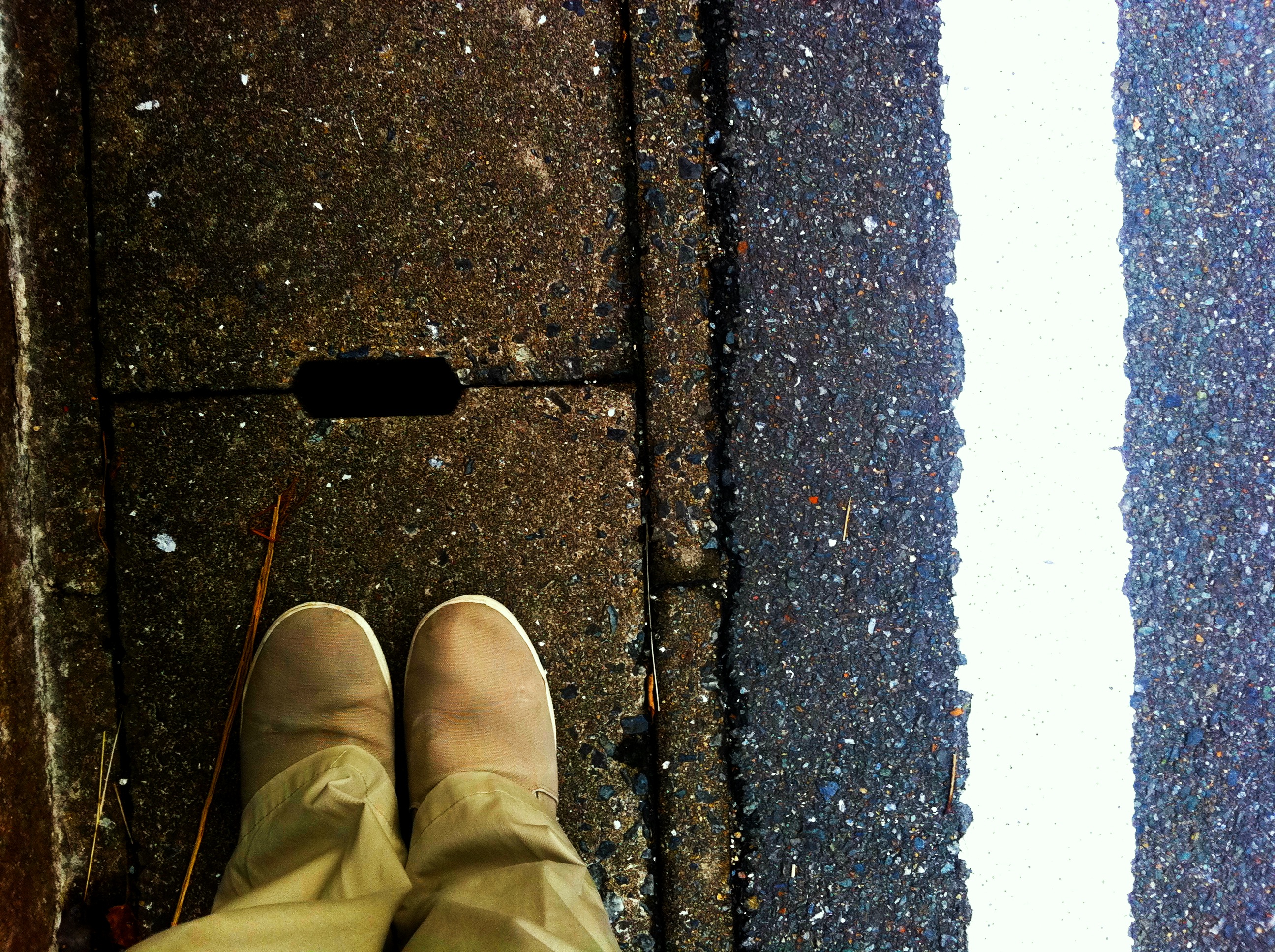
Sidewalks are narrow. In my city, they are slabs of stone set over a drainage system. They make a satisfying clunking sound when you walk on them. Bikes and people share space away from cars in an agitating spectacle of a good idea gone horribly wrong, but most of that can be summed up to poor teaching of right-of-way (The problem is much worse in denser cities).

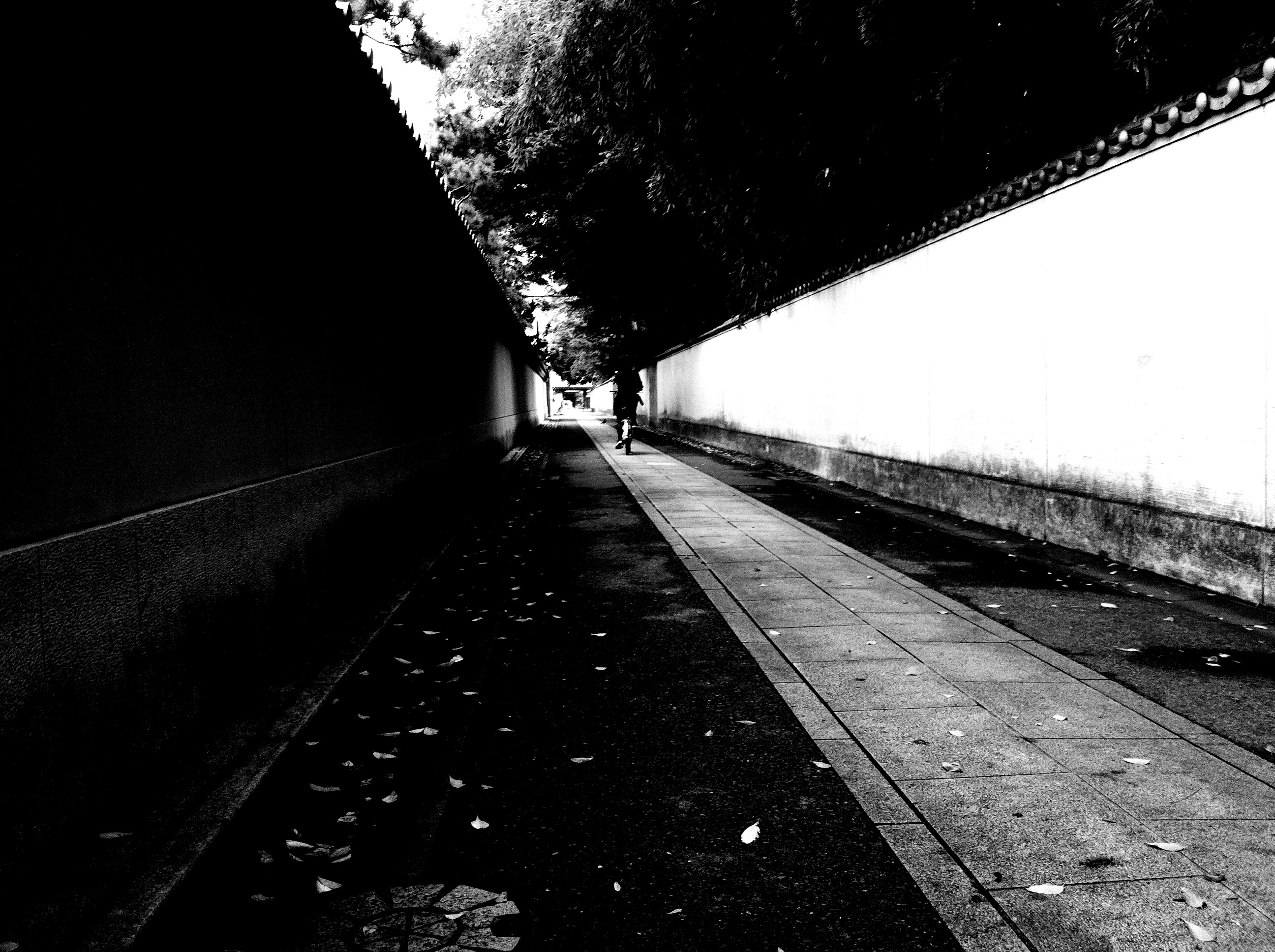
There is a “street wall” almost haphazardly built to accommodate the Japanese desire for privacy; this wall is usually made of stone, tall trees, or both. Sometimes these trees bear fruit: I can grab persimmon, oranges and pears every day as I walk home. The walls make me feel like I am wandering through a real map, with thick black lines on either side of me. It’s disorienting at first – especially since streets don’t have names, or buildings numbers – but soon you feel like the walls are a guide, and not a hindrance to free movement.

Yards are rare, but the unrelenting force of nature makes up for that. With volcanic soil and resilient, hyperlocalized species, any unplanned space quickly becomes a refuge for a thriving miniature ecosystem. It is not manufactured or landscaped. It is wild and leafy.

By comparison, America’s lawns and parking lots tend to be prohibitively unrestrictive. There is no sense of continuity between spaces; everything becomes a disjointed monument and the wide, open fields are unnatural and environmentally unsupportable. Which is ironic, because Japan actually is a collection of disjointed monuments.

Because residential areas wind like DNA around rods of commerce, you can shop, eat and play just outside of home. Within walking distance I have an enormous outdoor running track surrounding a pond, three udon shops, two grocery stores, two photo labs, a book/CD store and 300,000 conbinis. There are two banks, a cell phone retailer, a community center and a shrine. None of this effects my home, which, on the arc, looks to the side of a mountain and the lake.

Because of the spiral, and the direct routes to the center of the spiral, you have many ways to move from point A to B. This is great for walking dogs, jogging, biking or simply changing the route to work. As Kunstler points out, varied routes also means decreased traffic.

On Cars
The structure of Japanese suburbs is unchanged since the 1500’s, based on the connections between farms or access to the sea. This changed with the advent of the railway, which ushered in the era of commuting.

But cars are still rare. Parking lots are underground or stand in narrow strips between rows of buildings, essentially hidden by the buildings they offer space for. This inversion is the simplest and most ingenious method I’ve seen for the elimination of urban sprawl. Americans have it backwards – “parking lots are considered to be a welcome sign to motorists,” writes Kunstler.

Cars are not welcomed in Japan. Drivers end up being penalized by long waiting times in tiny parking lots, heavy tolls and an enormous gas tax. Trains are somewhat expensive as well, but you get what you pay for, including seat warmers in winter, air conditioning in the summer and wi-fi on subways (even in tunnels, though allegedly this is only because my city’s baseball team and stadium is owned by a cell phone and internet service provider).

The roads in the suburbs are narrow. They are winding inlets that make drivers dizzy, keeping all but the craziest drivers at low speeds, which is perfect for residents.

On The Rise of Japanese Sprawl
Most of the urban sprawl I see – the stuff you can only get to by car – feels hostile, on the verge of collapse. Likely these are the result of the boom at the end of the 1980’s that collapsed along with the housing and spending bubbles (see Sekia Hills, the resort that never should have been).

Or they could just be dying as more people abandon the American ideal of driving everywhere. The local Costco, which replicates its American counterpart down to the last ugly roof beam, is accessible only by car. It is a store designed for cars, after all – you can’t take four tubs of salsa and a year’s supply of Cocoa Krispies home on the subway. The parking lot is an endless sea of SUV’s, the only collection I have ever seen outside of America.

If there is an American influence on Japanese urban planning, it seems to be on the wane. We’ll see if America decides to learn anything from Japan.

Posted in Fukuoka, Uncategorized | Leave a comment

On Christmas in Japan | メリクリスマス!

I am not spending Christmas on a date at Kentucky Fried Chicken. But hey, I’m a foreigner.

Christmas in Japan
In the war on Christmas, we know what side Japan is on: The country is not inclined to celebrate the birth of Christ, given that less that 2 percent of the population are Christians. You don’t get the day off, an honor reserved for the Emperor’s Birthday (Dec. 23).

But a Japanese Christmas has traditions: You go shopping for a cake, buy presents, and try to score with your girlfriend: Christmas is a romantic holiday.

Valentine’s Day is traditionally a Sadie-Hawkins kind of affair in Japan, with women giving gifts of chocolate and affection to men who, characteristically, give them nothing in return.

So, as a young Japanese man, where do you take your girlfriend on the most romantic night of the year? If you want to follow the trends, you take her to Kentucky Fried Chicken. But don’t forget to make a reservation. Seriously.

KFChristmas
How did Kentucky Fried Chicken come to dominate Christmas in Japan? It’s not so far-fetched when you consider that the American version of Santa Claus is largely a product of Coca-Cola’s marketing efforts (hence the red and white trim).

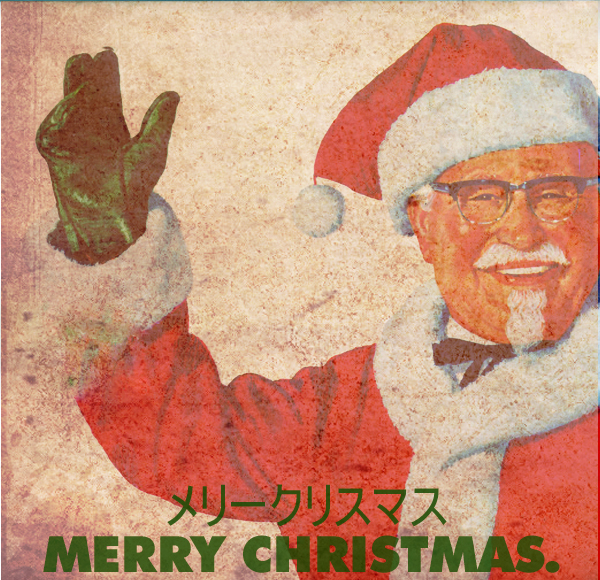
Col. Sanders (who never actually served in the military) has a terrifying, life-sized plaster statue in front of every KFC in Japan. In December, his traditional chef’s apron is replaced by a red coat and Christmas hat (Sanders is also sometimes dressed as a samurai).

A Japanese friend told me that growing up, she would see the enormous turkeys and chickens on the table in Tom and Jerry Christmas specials and associated it with America. People in Japan want whole roasted chickens to match that traditional look – but the Japanese oven is usually about the size of a microwave. It won’t fit a whole chicken.

So, since 1974, KFC has offered a package meal (“a set”) with a whole roasted chicken, salads and a Christmas cake (Strawberry and white frosting, a popular Japanese Christmas custom they seem to associate with the UK). You order it in advance, and take the meal home to have a giant, Tom-and-Jerry-sized holiday feast, carcass and all.

Christmas Music
At the underground mall connected to the train station in the city – a sprawling 2-block spread – the faux-French accordion music was replaced on Dec. 1, with four Christmas songs, one of which is the plague that Paul McCartney hath wrought upon the Earth, “Wonderful Christmas Time.”

The song rotation includes some crossover with my students’ lists of “The Top Christmas Songs in Japan,” which he handed to me with no prodding or explanation. Here are the contents of that list:

1. Wham! – Last Christmas
Everyone in Japan loves this song. There is a popular Japanese version, performed by a soul-rap group called EXILE, which has 14 members and its own train. (BONUS: The Sailor Moon cover). WHAM! FUN FACT: In almost every translation of this song into English, it’s happy. George Michael’s heartbreak is ignored, and the song becomes a more appropriate tribute to Christmas romance. The original version has always been misunderstood. Poor, misunderstood George Michael.

2. Mariah Carey - All I Want for Christmas
This song was used repeatedly in a Christmas episode of “In Love With Dinosaur,” aka “Falling in Love in the Eyes of the Unpretty,” a Japanese Ugly-Betty derivative based on an unattractive female comedian who seeks true love from a handsome TV news anchor. The news anchor must decide between Dinosaur and several attractive, educated ladies. The show went off the air and came back for a Christmas special, which used the first 20 seconds of this song on a loop as the background music for Dinosaur’s existential crisis. I have no clue how popular this show was back in 2006, but it’s all I can think about when I hear this song in Japan.


3. Tatsuro Yamashita – Christmas Eve
JR Railways licensed this song back in 1988 and has used it in commercials every Christmas since. The song enjoyed a brief success in America in 1984, when Tatsuro translated it into English, but the JR Railways campaign has kept it alive in Japan. In most of the commercials, a woman is late or waiting for a train. By far, the best one, for pure zeitgeist value, is the one where an 80’s new-wave rocker is worried that her boyfriend has stood her up, only to be surprised by a stranger break dancing in MC Hammer pants. Spoiler Alert! It’s her boyfriend! (It’s the first one in this video).


4. John Lennon/Yoko Ono – So This is Christmas (War is Over)
Since you all know this song, here is what appears to be a 1979 commercial for a local Japanese electronics store, featuring John Lennon and Yoko Ono. I don’t think they had John’s permission.

5. I don’t remember number 5. Either that or it was that awful Paul McCartney song.

Continue reading

Posted in Uncategorized | 15 Comments

On Sumo | すもう

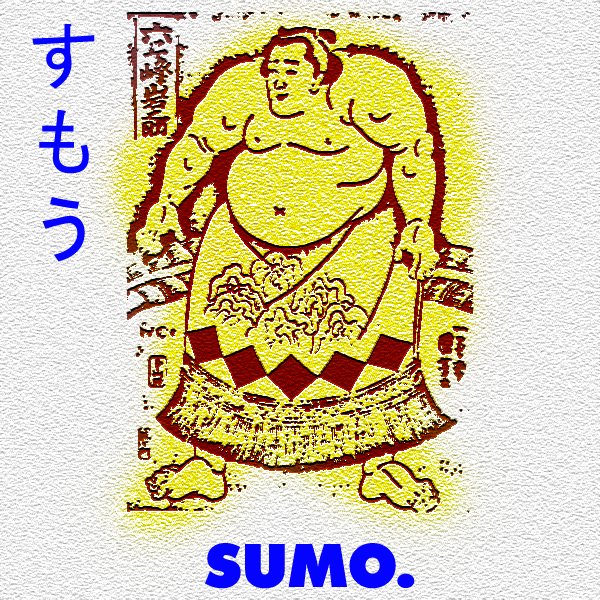
You could say that Sumo is “Japanese Wrestling.” But this would only be right if wrestling involved a Catholic Mass and the pretext that the cage match was to entertain Jesus.

The Sumo Ceremony
Like much of Japanese life, Sumo consists of extravagantly long bouts of formal ceremony leading up to short bursts of real activity.

Originally, Sumo entertained the Gods during regional Shinto festivals. The ceremonies of Sumo are still about two-thirds of a Sumo bout.

Matches begin with a formal procession of wrestlers wearing ceremonial silk gowns and whose names are read by a referee in a specialized voice. Then, the Yokozu-na, or grand champion, comes on stage and swings a 25-pound hemp knot, tied in the way Shinto shrines use to demarcate places of awe.

The wrestlers perform ceremonies. They raise their arms and stomp on the ground to frighten away negative kami. They drink water to purify their bodies and throw salt to purify the circle. There is chanting between each tier’s competition, and a ceremony of watering the circle in a kind of hypnotic spinning motion.

All of this ceremony is occasionally broken up with wrestling.

Sumo as Sport
Sumo is about throwing your opponent out of a 15-foot-wide circle. Any part of the body on the ground or out of the circle qualifies. Wrestlers have 4 minutes per round, and spend most of that slapping their chest, throwing salt around, aggressively squatting and getting ramped up.

After about 3 and a half minutes, the two mountains of manflesh dash at each other head-on. The match usually ends within 15 seconds. There is no “best out of three” mentality to Sumo. All of this buildup is for 15 to 30 seconds of war.

And it is war. I saw wrestlers flung from the circle into chairs twice. The occasional lock ends with two men furiously thrusting at each other to drain the other’s balance. Salt, water and hazelnuts erupted in a glorious spectacle as one man was sent rolling over the ceremonial corner of the ring.

Sumo Rankings
Size doesn’t matter, since there aren’t weight divisions. A wrestler weighing 380 pounds may seem to have an advantage, but the nimble, light-weight guys were usually victorious.

Matches go on for 15 days, and every wrestler faces each other. Winning the title is different from being named Yokozu-na. The Yokozu-na is determined by judges after a wrestler wins two matches in a row, and includes evaluations of character. Only 68 wrestlers have ever been named Yokozu-na, and only one of them is wrestling today. Once you are a Yokozu-na, you can’t lose it.

Sumo Training
The training process for Sumo begins at age 15 at a communal training center, or stable, where you join as a lower-ranked wrestler with cleanup duties and other menial tasks, which is common in any traditional Japanese craft (consider Sushi chefs). Life is not pleasant.

Wrestlers eat high-calorie meals of a special kind of Nabe (a soup), washed down with bottles of beer. Apprentice Sumo serve their masters and are left only with the leftover Nabe. This nugget sums up Sumo life with a somewhat amazing tidbit (emphasis mine):

“Apprentices live a spartan existence, training, sleeping and eating twice daily a fattening broth in a sort of monastic collective that has few parallels in professional sport. Until the association recently outlawed it, discipline was enforced with a yard-long bamboo stick. Stable masters oversee strict hierarchies, only slightly exaggerated in the widely believed rumour that apprentices wipe the bottoms of the older wrestlers. “That used to go on, but it has been stopped,” says Kotooshu.”

Sumo blends wrestling with football practice. The training process includes fighting everyone in your stable until you are defeated or you defeat everyone. If you defeat everyone, the traditional response is for everyone to gang up on you.

This kind of anarchy is limited once you enter the ring. Then, it’s 4 minutes of staring at each other before lifting a finger.

The End of Sumo
Like a lot of traditional arts in Japan, Sumo is seeing a rapid decline in audience and participants. Perhaps because of the “softening” of Japanese youth, or absent Japanese youth, Sumo must look outside of the country for its wrestlers. And the lack of any Sumo tradition outside of Japan means a dearth of available talent.

Add to this a string of scandals – from gambling and organized crime ties (our tickets literally said “No Gangsters” on the back) to the death of a 17-year-old apprentice and you can see the loss of Sumo’s luster.

Can Sumo survive? It’s possible. But faced with an aging population, Japan as a whole is struggling to find the best path to survival. Should Sumo relax its rules against foreigners? Part of that debate mirrors a broader discussion of immigration, which the country is ignoring for the science-fiction fantasy of a robotic Japan.

Will we see robot sumo alongside electronic waitresses and cybernetic housekeepers? God, I hope so.

Posted in Shinto, Tradition | 4 Comments